

25th Sep 2026
The Great Vent Closing Debate: Does Shutting Vents Actually Save Money?
It is the most common piece of money saving advice passed down from generations of homeowners. If you have a guest bedroom that nobody uses, simply walk in, slide the metal lever on the floor register to the closed position, and shut the door.
The logic feels completely flawless. Why pay to heat or cool an empty room? By closing the vent, you assume you are forcing all that expensive conditioned air into the living room and the kitchen where you actually need it.
It sounds brilliant, but it is completely wrong. Shutting the vents in your unused rooms does not save you a single dime on your utility bill. In fact, it is one of the fastest ways to destroy your heating and cooling equipment and guarantee a massive, entirely avoidable repair bill.
Here is the truth about how your airflow actually works, and why you need to go open all your vents right now.
The Physics of the Closed Loop
To understand why closing a vent is a bad idea, you have to understand how your air conditioner and furnace operate. Your HVAC system is not a smart, adaptable network of pipes. It is a closed, perfectly balanced loop of pressure.
When your system was installed, it was carefully sized to push and pull a very specific volume of air based on the square footage of your entire house. The blower motor does not know that you closed the guest room vent. When it kicks on, it just keeps pushing that exact same massive amount of air against a newly created metal wall.
What Happens When the Air Has Nowhere to Go
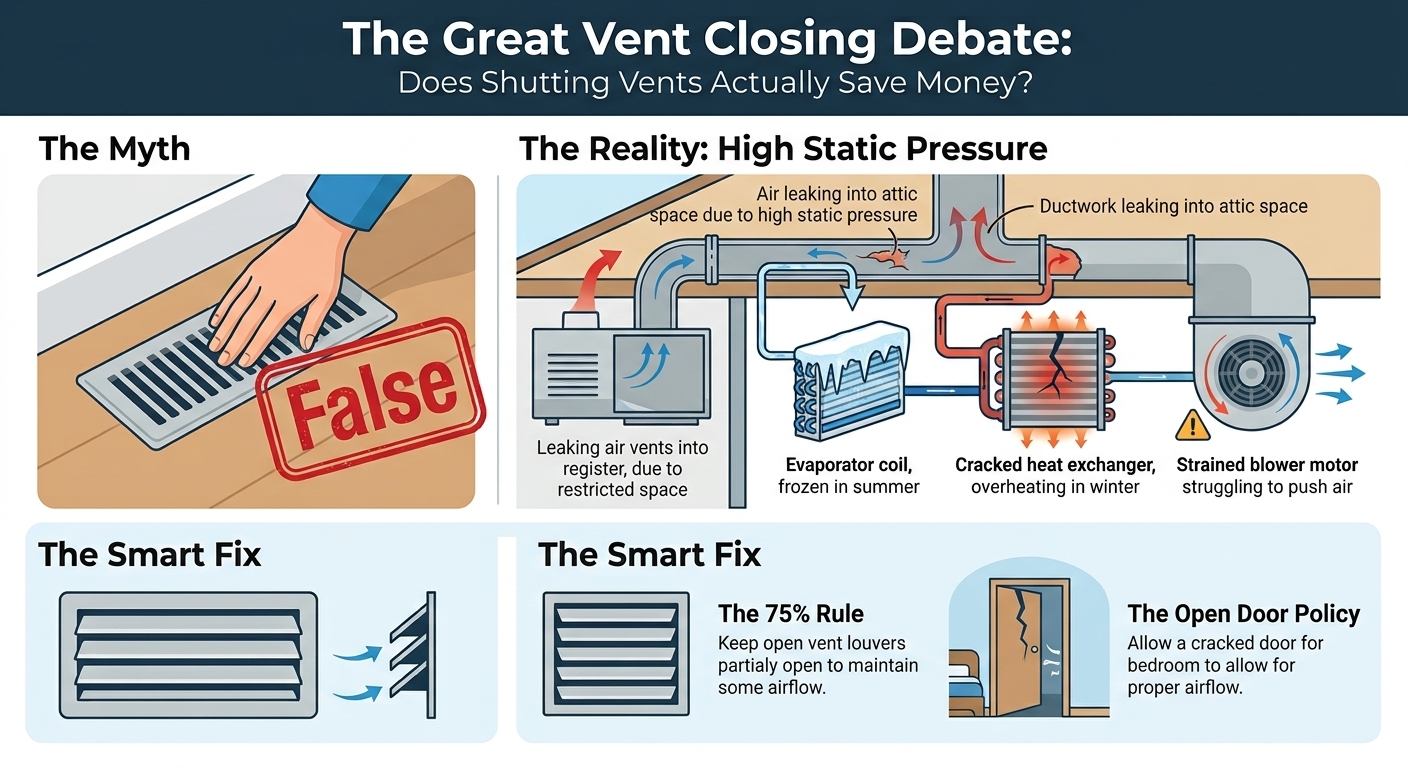
When you close the vents in an unused room, that air does not magically reroute to your master bedroom. It backs up inside the ductwork. This creates a dangerous condition known as high static pressure.
Here is exactly what that pressure does to your house.
-
The Ductwork Blowout: Your metal ductwork is held together by tape and screws. It is not designed to hold back a high pressure air pocket. When the air backs up, it violently forces its way out of the tiny seams and joints in your attic or crawlspace. You end up paying to air condition the squirrels in your attic instead of your living room.
-
The Summer Freeze: In the summer, restricted airflow prevents enough warm house air from blowing over your indoor evaporator coils. Without that warm air, the condensation on the coils freezes solid, turning your AC into a useless block of ice.
-
The Winter Bake: In the winter, restricted airflow traps the intense heat inside the furnace chassis. The internal heat exchanger will rapidly overheat, warp, and potentially crack, which is a catastrophic failure that requires a total system replacement.
-
The Blower Motor Death: Your blower motor is the heart of the system. Forcing it to constantly push against blocked vents causes the motor to strain, pull massive amounts of electricity, and eventually burn itself out entirely.
The Lazy Genius Compromise
You still want to be efficient, and you still do not want to waste energy on a room you never use. Instead of completely suffocating your system, use these two airflow hacks to manage your temperature safely.
1. The 75 Percent Rule
Do not close the vent completely. You can safely restrict the airflow to a specific room by closing the louvers about 75 percent of the way. This dramatically reduces the amount of hot or cold air entering the unused room, but it still leaves enough of an opening for the static pressure to escape safely.
2. The Open Door Policy
If you restrict the vent in a guest room, do not close the bedroom door tight. Your system relies on return vents to pull air back to the main unit. If the guest room does not have its own dedicated return vent, closing the door traps the air inside the room. Leave the door cracked open a few inches so the air can flow back out into the hallway and equalize the pressure.
Your heating and cooling system breathes just like you do. Stop putting a hand over its mouth. Walk through your house today, make sure your registers are open and clear of heavy furniture, and let your equipment do exactly what it was designed to do.