

23rd Oct 2026
The Empty House Dilemma: Should You Turn Your HVAC Off When You Go to Work?
You grab your keys, pour your coffee, and head for the front door. You are going to be at the office for the next nine hours, and the house will be completely empty.
As you walk past the thermostat, you face the ultimate homeowner dilemma. Do you turn the system completely off to save electricity while you are gone, or do you leave it running so you do not come home to a boiling oven?
Homeowners have been fiercely debating this daily routine for decades. One side insists that cooling an empty house is financial sabotage. The other side claims that turning the system off makes it work twice as hard to catch up later.
They are actually both wrong. If you want to keep your utility bills low and your house comfortable, you need to stop treating your thermostat like a simple on and off switch. Here is the actual physics behind cooling an empty house.
The Problem with Turning It Completely Off
The logic behind turning your system off seems flawless. If the machine is not running, you are not paying for electricity. But this strategy completely ignores a scientific concept called thermal mass.
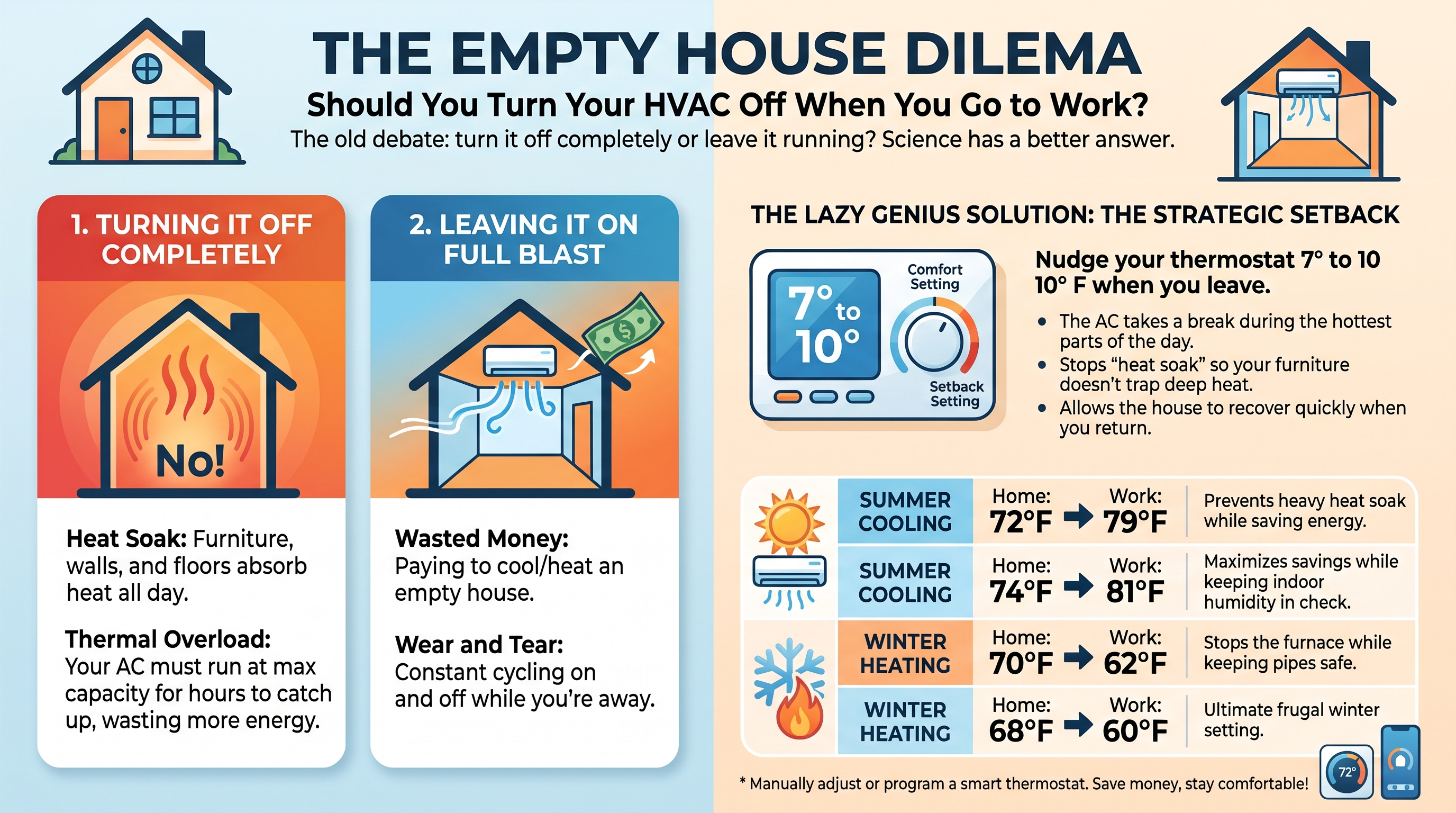
Your house is not just a bubble of air. It is filled with drywall, hardwood floors, heavy sofas, and thick mattresses. When you turn your air conditioner off on a hot summer morning, the ambient air temperature inside the house rises quickly. As the air gets hot, all of that physical furniture begins to absorb the heat. It is called heat soaking.
When you get home at six in the evening and turn the AC back on, the system is not just cooling the air. It has to physically rip the deep, trapped heat out of your couches, your carpets, and your walls. The air conditioner will roar for four hours straight at maximum capacity just to overcome the thermal mass. You end up burning significantly more electricity trying to recover the temperature than you saved during the day.
The Problem with Leaving It Alone
The opposite extreme is just as bad. Some homeowners leave their thermostat set to a crisp 70 degrees around the clock.
If nobody is home, you are paying a massive premium to keep your dining room table perfectly chilled. Your air conditioner will cycle on and off all day, fighting the afternoon sun to maintain a strict temperature for an empty room. This adds hundreds of dollars to your annual utility bill for absolutely zero human benefit.
The Lazy Genius Solution: The Strategic Setback
The secret to saving money without heat soaking your furniture is the setback strategy. You want to let the house warm up enough to stop the AC from running constantly, but you want to keep it cool enough that the furniture does not turn into a giant radiator.
The Department of Energy has done the math for you. The magic number is seven to ten degrees.
Before you leave for work, simply nudge your thermostat up by seven to ten degrees from your ideal comfort setting. If you like the house at 72 degrees when you are home, set it to 79 degrees when you leave.
This creates a perfect balance. The air conditioner will take a long break during the hottest parts of the day, saving you a massive amount of electricity. But because the house is capped at 79 degrees, the thermal mass never reaches a critical boiling point. When you get home and lower the temperature, the system can quickly and easily recover the climate in less than an hour.
The Daily Adjustment Guide
| Your Preferred Temperature | The Workday Setback | The Result |
| Summer Cooling (72 Degrees) | Set to 79 Degrees | Prevents heavy heat soak while stopping midday AC cycles. |
| Summer Cooling (74 Degrees) | Set to 81 Degrees | Maximizes energy savings while keeping indoor humidity in check. |
| Winter Heating (70 Degrees) | Set to 62 Degrees | Stops the furnace from running all day while keeping pipes safe. |
| Winter Heating (68 Degrees) | Set to 60 Degrees | The ultimate frugal winter setting for a vacant house. |
You do not have to choose between a terrifying electric bill and a miserable, sweltering living room. Whether you manually nudge the dial on your way out the door or program a smart thermostat to do it for you, the setback strategy is the ultimate compromise. You protect your bank account, you protect your equipment, and your house is perfectly comfortable right when you walk through the door.