

7th Aug 2026
Do Solar Attic Fans Actually Help Your AC Run Better?
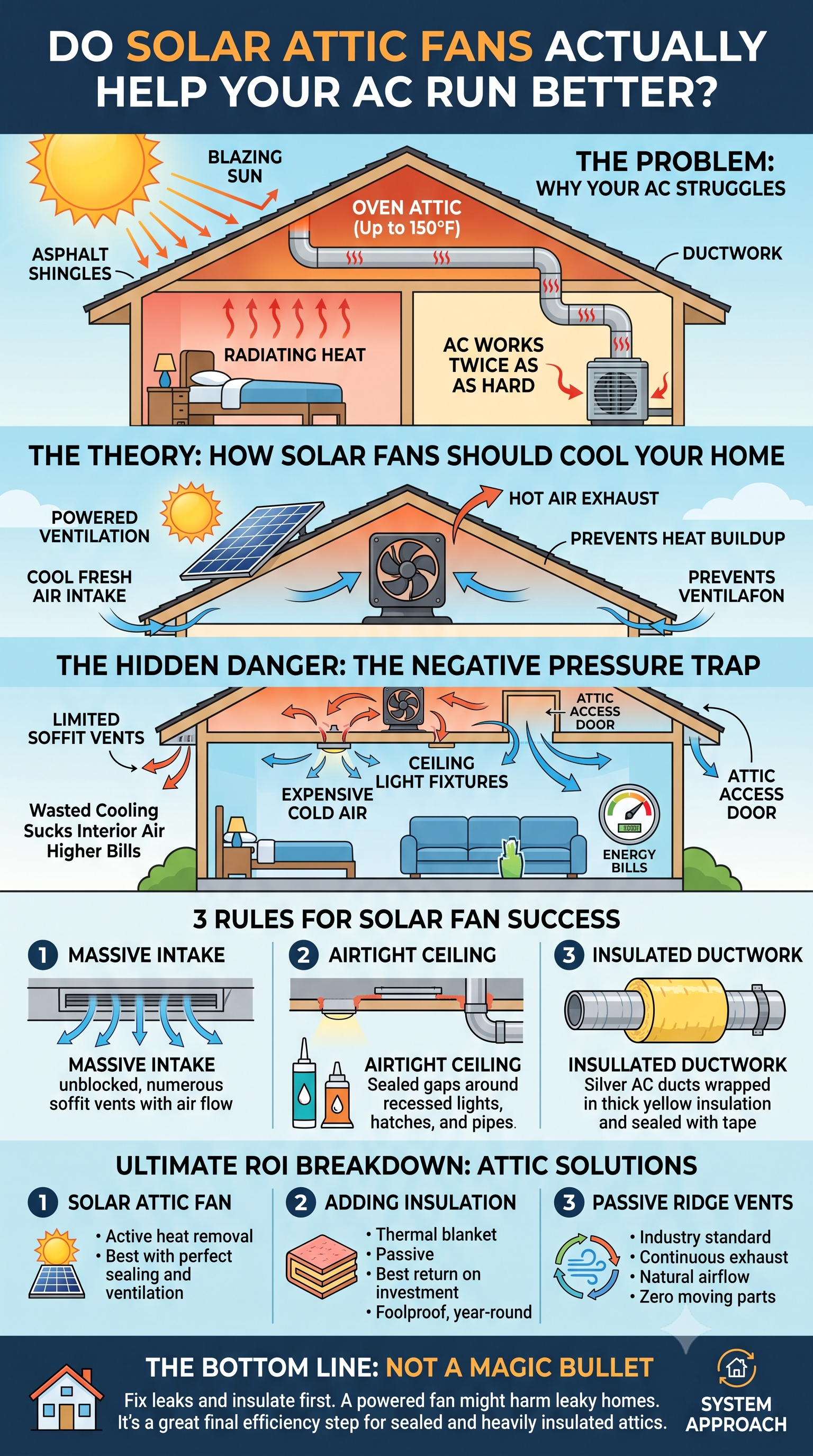
It is the middle of July. The sun is beating directly down on your asphalt shingles, and right now, the space directly above your ceiling is slowly turning into a massive, 150°F oven.
When your attic gets that hot, the heat has to go somewhere. It radiates straight down into your living space, forcing your air conditioner to work twice as hard to keep your house cool. If your ductwork runs through that boiling attic, your AC is actively fighting a losing battle before the cold air even reaches your vents.
Enter the solar attic fan. It sounds like the ultimate lazy genius life hack. You harness the free power of the sun to suck the boiling air out of your attic, which cools down your house and lowers your energy bill.
But does it actually work, or is it just another expensive home improvement myth? The answer is complicated. Here is the absolute truth about solar attic fans and whether they are actually helping your HVAC system.
The Theory of the Solar Fan
The concept is incredibly straightforward. A solar panel powers a fan mounted on your roof. As the sun beats down and the attic heats up, the fan kicks on. It forcefully exhausts the trapped hot air out into the atmosphere, drawing cooler, fresh air in through the soffit vents under your eaves.
By mechanically forcing the air to circulate, the fan prevents the attic from reaching those catastrophic 150°F temperatures. A cooler attic means less heat radiating into your bedrooms, which translates to a lower workload for your air conditioner.
The Hidden Danger: The Negative Pressure Trap
In a perfect world, a solar attic fan works exactly as advertised. But houses are rarely perfect. Here is the massive flaw that most homeowners discover entirely too late.
A powerful solar fan moves a massive volume of air. To push that air out, it needs an equal amount of fresh air to come in. If your attic does not have enough intake vents along the edges of the roof, the fan is going to find air wherever it can.
Instead of pulling fresh air from outside, the fan will create negative pressure and start sucking the cold, expensive, air conditioned air straight out of your living room. It will pull it right through the tiny cracks around your ceiling light fixtures and attic access doors.
You installed the fan to save money, but you might accidentally end up paying to air condition your attic.
The 3 Rules for Solar Fan Success
If you want an attic fan to genuinely relieve the pressure on your HVAC system, you cannot just slap it on the roof and hope for the best. You have to follow the rules of airflow.
1. You Must Have Incredible Intake
Before you even consider a fan, walk outside and look under the eaves of your roof. You need clear, unblocked soffit vents. If your vents are painted shut or stuffed full of old insulation, the fan will choke.
2. You Must Seal the Floor
Your attic floor needs to be completely airtight. You have to seal the gaps around your recessed lights, the edges of the attic hatch, and the holes where plumbing pipes go down into the walls. If the ceiling is sealed, the fan cannot steal your conditioned air.
3. Your Ductwork Must Be Insulated
If you have silver AC ducts running through your attic, they need to be wrapped in a thick layer of insulation and totally sealed with mastic tape. Leaky ductwork in a depressurized attic is a recipe for catastrophic energy loss.
The Ultimate ROI Breakdown: Fan vs. Insulation
Before you spend hundreds of dollars installing a fan, you need to look at the other, significantly more boring option. Adding insulation is often the smarter financial move.
| The Solution | How It Works | The Verdict |
| Solar Attic Fan | Actively removes heat from the attic space. | Situational. Excellent if you have perfect attic sealing and massive soffit ventilation. |
| Adding Insulation | Acts as a thick thermal blanket, stopping the heat from entering your living space. | Foolproof. The absolute best return on investment for 90 percent of homes. It works passively year round. |
| Ridge Vents | Passive exhaust vents cut entirely across the peak of the roof. | The Industry Standard. Requires zero electricity, has no moving parts to break, and creates perfect natural airflow. |
The Bottom Line
A solar attic fan is not a magical silver bullet. If you have an older home with a leaky ceiling and poor intake ventilation, a powered fan will likely do more harm than good by stealing your cold air.
However, if your attic is properly sealed and heavily insulated, adding a solar fan is a fantastic way to exhaust that trapped summer heat. Treat your home like a complete system, fix the leaks first, and let your air conditioner finally catch a break.
Lastly, dont forget the filter! Its important to keep your HVAC breathing well and filtering the particles in the air away from the critical components of your system. HVACFilters offer great value filters of all MERV ratings, with Free shipping and amazing customer service. We are looking forward to helping you with all of your HVAC filter needs!