

29th May 2026
Decoding the Filter Aisle: What MERV Means and Why It Matters
Standing in the hardware store and staring at a wall of air filters can feel like trying to read a foreign language. Every box is shouting numbers and percentages at you. But if you want to keep your air clean and your HVAC system alive, there is only one acronym you actually need to care about.
MERV.
Understanding this single rating is the difference between breathing easy and accidentally suffocating your expensive furnace. Here is exactly what those four letters mean and why they are so incredibly important.
What Does MERV Actually Mean?
MERV stands for Minimum Efficiency Reporting Value.
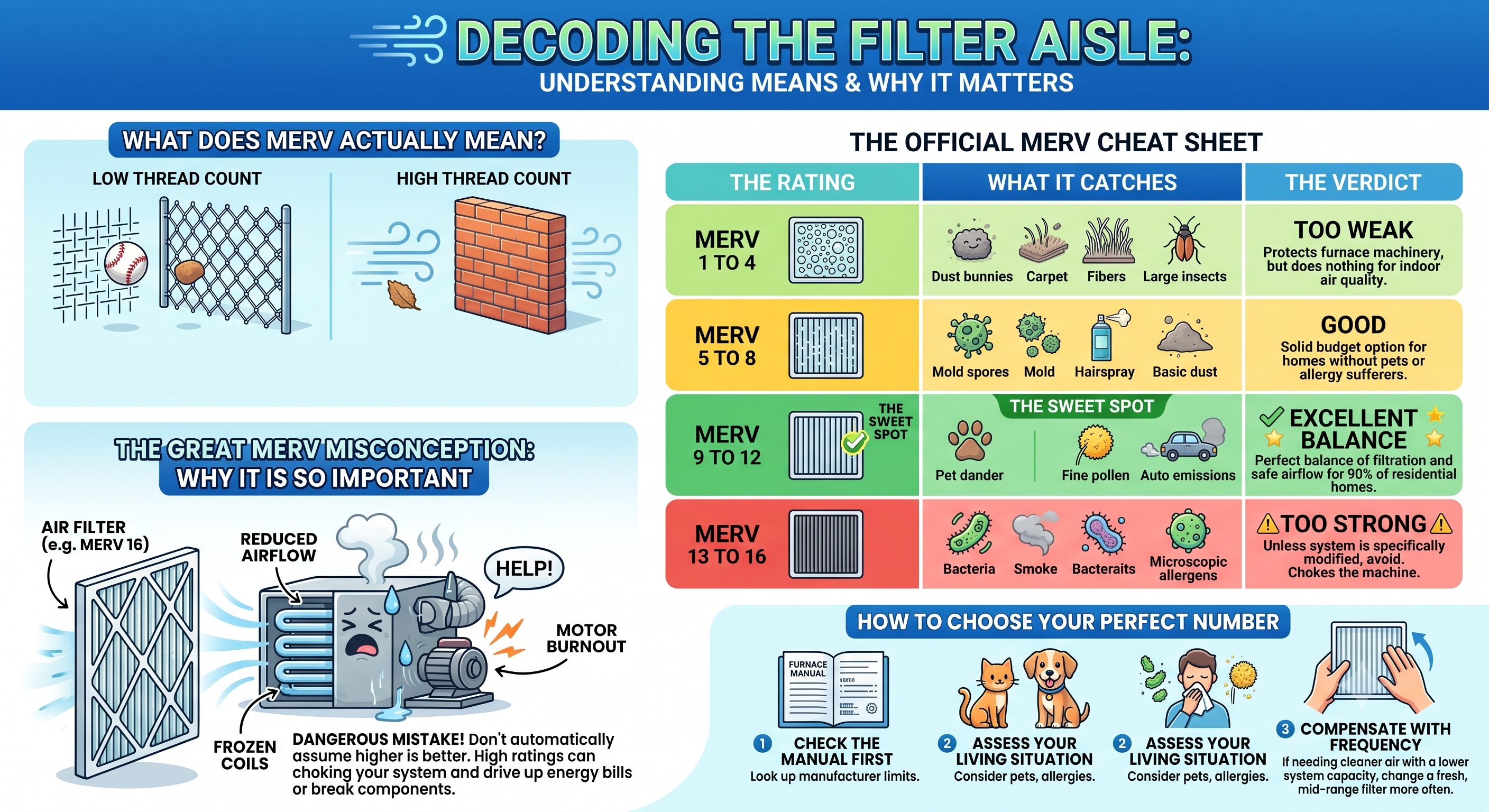
If that sounds like boring industry jargon, it is. The easiest way to think about a MERV rating is to compare it to the thread count of your bed sheets. The higher the MERV number, the tighter the weave of the filter material.
A filter with a low number is like a chain link fence. It will stop a stray baseball, but the wind blows right through it. A filter with a high number is like a solid brick wall. It stops absolutely everything, including the breeze itself.
Ratings typically run on a scale from 1 to 16 for residential use. As the number goes up, the filter becomes capable of trapping smaller and smaller microscopic particles.
The Great MERV Misconception: Why It Is So Important
Here is where most well meaning homeowners make a massive, expensive mistake. It is completely natural to assume that a higher number is automatically better. You want the cleanest air possible, so you reach for the MERV 16.
This is a dangerous misconception.
Your heating and cooling system was engineered to pull in a very specific, massive volume of air. It needs that air to breathe, to push conditioned air into your rooms, and to keep its own internal motors from overheating.
If you install a hospital grade filter with an incredibly high MERV rating into a standard residential system, you choke the machine. The blower motor has to work twice as hard to pull air through that dense material. This drives up your energy bill, freezes your AC coils, and eventually burns out the motor entirely.
The Official MERV Cheat Sheet
To keep things simple, here is a breakdown of what the different rating tiers actually do and where they belong.
| The Rating | What It Catches | The Verdict |
| MERV 1 to 4 | Dust bunnies, carpet fibers, and large insects. | Too Weak. These filters protect the furnace machinery but do absolutely nothing for your indoor air quality. |
| MERV 5 to 8 | Mold spores, hair spray, and basic dust. | Good. A solid budget option for homes without pets or allergy sufferers. |
| MERV 9 to 12 | Pet dander, fine pollen, and auto emissions. | The Sweet Spot. This is the perfect balance of excellent air filtration and safe airflow for 90 percent of residential homes. |
| MERV 13 to 16 | Bacteria, smoke, and microscopic allergens. | Too Strong. Unless an HVAC technician specifically modified your system to handle this density, avoid these. They will suffocate your unit. |
How to Choose Your Perfect Number
Finding your ideal MERV rating comes down to understanding your specific household.
1. Check the Manual First
Before you buy anything, look up the manual for your specific furnace or air handler. Most manufacturers list a maximum recommended MERV rating right in the specifications. If the manufacturer says not to exceed MERV 11, believe them.
2. Assess Your Living Situation
If you live alone in a pet free home, a MERV 8 will serve you perfectly. If you have two shedding dogs and a kid with seasonal allergies, you will want to bump that up to a MERV 11.
3. Compensate with Frequency
If you want cleaner air but your system cannot handle a heavy duty filter, there is a simple workaround. Buy a mid range filter, like a MERV 8, and change it every 30 days instead of every 90 days. A fresh, lower rated filter will always outperform a heavy, clogged one.
Understanding MERV takes the guesswork out of home maintenance. Pick the right number, swap it out consistently, and let your system do exactly what it was designed to do. With HVACfilters.com you can have the sizes and MERV ratings you need to protect your system and your home.